Research & Design

Is Singapore’s public transport system ready to support our aging population?
Design Inquiry: Analysis and Synthesis Slidedoc
Roles Performed: Prepared research kits for participants, conducted expert evaluation of signage, analysed findings and compiled insights
Project Location: Singapore
Project Timeline/Duration: 18 January 2024 to 4 April 2024

The Challenge
To understand the usage of public transport by Singapore’s elderly and explore how to accommodate their public transportation needs. We presented our findings and insights to our client, the Public Transportation Agency.
Is Singapore’s Public transport system ready
to support our aging population?
Literature Review
To understand the problem of an aging population in Singapore’s context and related trends
To get some background on the challenges that our elderly face which are related to transportation
To understand how Singapore’s public transportation system currently supports senior citizens’ needs and identify potential gaps in achieving this
Approach
The research findings in the literature review seeks to identify the trends in the public transport system and help us focus on potential areas that seniors find challenging when taking the bus or MRT.
Understanding Daily Ridership Trends
According to (Ministry of Transport, 2023), in the third quarter of 2023, the average daily ridership on public buses and trains were 7.9 million rides on weekdays and 6.4 million rides on weekends. (Tan, 2023) noted that MRT and bus ridership during post Covid pandemic continued to rise with MRT and LRT rides leading the growth with a 30 per cent increase in 2022 to 2.93 million rides per day, while buses chalked up a 15 per cent rise to 3.46 million rides which showed an increased demand as more lines are built.
This shows that there is a steady increase in ridership for both MRT and bus across pre and post pandemic. Both modes of transport continue to remain the main choice for Singaporeans for their daily commute which includes seniors.


Challenges that seniors face
Yeo, (2015) noted that LTA were rolling out more initiatives that focused on accessibility, safety, comfort and ease for seniors. These were the top priorities voiced by them in a 2015 focus group study. Seniors were using both bus and MRT for their daily commute.
Also, LTA is looking at enhancing all 360 bus stops to be upgraded by mid-2025 to make them safer and senior- friendly. A suggestion by Chairman of RSVP Singapore was to find out what seniors want before implementing any changes, especially with safety as a concern (Kok, 2022). These findings show that more studies are needed to understand the needs of seniors as current studies are limited. Despite LTA making enhancements, seniors still struggle to get around both the bus and MRT.
In addition, the focus group study (Yeo, 2015) had identified useful areas for consideration and we will be studying them in greater detail.

We identified various focus areas for further research:
Accessibility
Assistance services
Comfort
Information and communication
Safety
Explore and Observe:
User Observations & Survey
User Observations

We performed detailed observations on the behaviours, interactions and challenges our elderly face while using public transport. 30 minute observations were conducted at Punggol Bus Interchange and Punggol MRT Station. During these observation sessions, we documented peculiar behaviour patterns and preferences exhibited by elderly users.
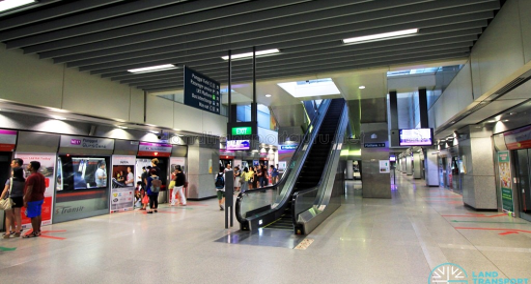
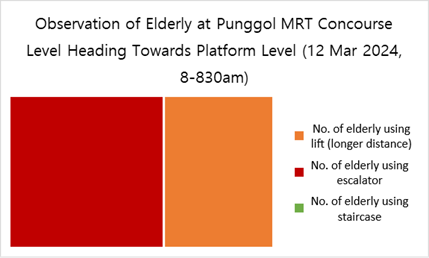
We found that our elderly often opt to take longer routes to use lifts or ramps instead of stairs. There is an aversion to using digital devices for help or navigation, with elderly preferring to read signages and seek help via direct human interaction.


Survey and Observation Statistics - Observation Raw Dataset
Most Important Findings
Observation of Elderly at Punggol MRT Concourse Level Heading Towards Platform Level (12 March 2024, 8-8:30 am)


Online Survey
A survey of 30 seniors aged 65 to 79 was conducted to obtain primary research on the focus areas identified in our literature review. We asked respondents to rank their preferences on a scale of 1 to 5 where 5 is the highest priority and 1 is the lowest priority. We also asked open-ended questions to elicit their thoughts and feelings about using the bus or MRT. Having a sample size of 30 allows us to obtain results representative of the population according to the Central Limit Theorem.


Based on our survey results, assistance services and information communication were the areas of highest importance to our seniors. We also found a need for clearer signages and support from transport staff in navigation. Therefore our further studies would focus on these areas.


Understand
Users In-Depth
Cultural Probes
Cultural probes are an autoethnographic approach to collecting insights. Participants were tasked to follow the instructions and self-document their experiences according to the questions on the forms. We chose to conduct cultural probes because self-documentation of experiences allow our participants to complete the studies at their own time and convenience. Having a researcher follow participants on their public transport journeys is less practical compared to self-documentation. Cultural probes allow us to elicit and collect unbiased data at the moment noteworthy experiences occur.
Visual Maps
I drew up scale diagrams of the most common layouts of buses and MRT passenger cars to scale, then asked our users to place stickers to indicate particularly positive or negative experiences they faced while on their journey. This allows us to empathize better with our users, while visualizing their journey with them.
It also helps the users internalize these experiences and note them down so that they can describe them in detail in the following forms:


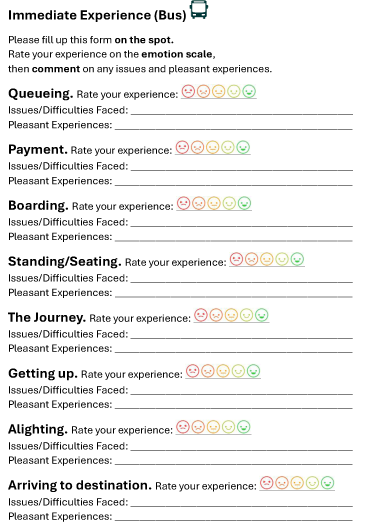
Immediate Experience Form
I included an Immediate Experience form so they can describe the various steps of their journey in detail. The user fills up the Immediate Experience Form on the spot with details on any pleasant experiences or difficulties they faced. There is also a Likert scale for the user to describe how they felt at that step of their journey.

Overall Journey Form
I also included an Overall Journey form for the user to reflect on good and bad experiences and what was memorable.


Response Key Insights
We summarized participants’ responses and uncovered the following key insights:
-
Crowding issues impact mobility and comfort by introducing difficulties during queueing, boarding, standing, and alighting due to lack of room and movement space. This is especially so during peak hours, which exarcebated mobility issues and discomfort for seniors.
-
Safety concerns were highlighted, especially regarding stability while standing on buses and MRTs. For example, challenges in staying stable when buses brake abruptly, and the need to hold the handrail tightly when there is a lack of seats on the MRT.
-
There might be a need to install infrastructure improvements catering to seniors’ specific needs. For example, installing racks for luggage or heavy items to alleviate physical strain for seniors carrying them.
-
Some participants called for drivers and public transportation staff to be more friendly and service-oriented. Beyond enhancing physical infrastructure improvements, enhancing the quality of service and interaction with public transportation staff can significantly impact seniors’ public transport experience.
-
Frequency of bus and train services could be increased to reduce crowding and address pain points of mobility and safety, making public transport more accessible and user-friendly for senior citizens.
Evaluate Existing
Solutions
Cognitive Walkthrough
This is an expert review where we put ourselves in the shoes of the elderly and see things from their perspective as trained evaluators. We break down a process into steps to question whether the user knows what to achieve and what to do to achieve those goals. We take a closer look at each step in the user flow using our best judgement to determine if user needs are met and tools used to guide the user work as intended. This is an evaluation conducted by experts who know what to look for objectively and without introducing assumptions and personal biases. Our studies consider what the elderly might be thinking and feeling and their emotional state at that point in time, which may diminish the effectiveness of user interfaces and signage systems.
We break down a process into its simplest steps and ask the following questions for each step:
Will the user try to achieve the right effect?
Will the user notice that the current action is available?
Will the user associate the correct action with the effect he or she is trying to achieve?
If the correct action is performed, will the user see that progress is being made towards solution of the task?
We selected two processes for closer examination using our cognitive walkthrough:
Process 1:
Topping up of farecards using the self-service machine
Process 2:
Transferring from MRT to a bus at a bus interchange
These two processes were chosen because they are well defined, can be broken down into steps, and any deviation from the expected goals and actions will result in confusion.
We must ensure that any technological solution must cater to the diverse needs of users, including seniors who might not be familiar with digital interfaces. Signage systems must be intuitive, readable and easily understandable with little ambiguity with regards to their intended purpose.
From this exercise we found that senior citizens benefit from clarity of signages and digital displays. High contrast signs and screens, large fonts, tooltips and visual cues are especially helpful. These will help them locate amenities such as information maps and understand the available actions such as selecting a language or identifying the card slot.
Many seniors have difficulty understanding digital interfaces, affecting their ability to associate actions with their intended outcomes. Visual and auditory feedback, such a green light indicator or a sound upon successful payment, is essential for reassuring seniors that they are progressing correctly through the top-up process.


Evaluation Findings
Some seniors will be so overwhelmed by station layout that they will want to get to street level immediately and end up at an exit furthest from their destination.

Even when we provide information guides and panels, we cannot assume that elderly users are looking for them for assistance. The ‘i’ sign indicating presence of an area map has insufficient contrast and lack of eye-catching colours despite its importance.

There is no indication that progress is being made (distance remaining) when walking towards a destination. Signs on private property are stylized arbitrarily and may not be clear or understandable.

There are specific signages for priority seating, priority boarding and priority use which are most relevant to the elderly, and they will be actively looking out for these.


Generate Insights
We analysed and put together the findings from our various studies. The common themes uncovered through our research are:
Discoverability
We should not assume that the elderly are actively looking out for accessibility features provided for them. We also should not assume that the elderly know which actions to perform to achieve their goals. All improvements must be highly visible and supported by promotional initiatives.
Continual Demand
All access points and amenities must continually cater for our elderly, particularly those with mobility challenges.
Technology
Elderly prefer seeking assistance through human interaction over digital devices. Where there is machine interaction, clear signage, visual aids and intuitive interfaces are required to help them locate machines and complete transactions confidently. Among our elderly, there are varying levels of familiarity with digital interfaces.
Safety
Some concerns about safety while standing on buses and trains might indicate broader issues around elderly passengers’ comfort and safety during transit.
Service
Elderly passengers would appreciate assistance services for them to navigate bus routes and facilities. It is also important for drivers to be friendly and helpful.
Scenarios such as being in an unfamiliar part of town might introduce stress and affect the intuitiveness of systems and navigation features.