Research & Design

Helping households save electricity through gamification
Project Type: Research and UX Prototyping, Solo Project, Medium-fidelity
Project Timeline/Duration: January 2025 to April 2025
The Challenge: Helping Singapore households save electricity by translating behavioural research into a gamified, habit-forming mobile app. Designs are presented at medium fidelity to prioritise structure, behaviour and decision-making.
Tools: Figma, Midjourney

Problem Statement
Electricity in Singapore is primarily generated by burning natural gas, a process that releases greenhouse gases such as carbon dioxide and methane. These gases trap heat in the atmosphere, contributing to global warming.
As global temperatures rise, ice sheets and glaciers melt, causing sea levels to increase. For low-lying countries like Singapore, rising sea levels pose a real risk of severe flooding.
No single government, corporation, or nonprofit can mitigate the effects of climate change alone. Individual contributors to climate change must act collectively because they can make a difference.
Households account for about 15% of Singapore’s total electricity consumption. Consumption per household may vary by 2-3 times due to individuals’ behaviour.
-
We need to understand household electricity consumption so individuals can engage in electricity conservation
-
We need to reduce the psychological distance between household electricity consumption and its harmful effects on climate change.




Key and Supporting Questions
How do individual, social and behavioural factors influence sustained electricity conservation efforts in Singapore households?
-
How might we help individuals understand the impact of their electricity consumption?
-
What are the motivations affecting electricity conservation behaviours among individuals?
-
What are the barriers affecting electricity conservation behaviours among individuals?
-
How are electricity consumption decisions made within households? What influences these decisions?
-
How do social norms influence electricity consumption behaviours?
-
How do family members teach each other about the importance of saving electricity?
-
What factors contribute to the persistence of electricity conservation behaviours over time?
Definitions
-
Households refer to a collection of individuals living together.
-
Individuals refer to individuals within households
-
Homeowners refers to those responsible for the household electricity bill
-
Electricity consumption refers to household electricity consumption
In this project, I am focusing on households from 4-room, 5-room and Executive flats.
In Singapore, 4-room, 5-room and Executive flats contribute to 45.6% of total household electricity, the most out of all household segments.
53.7% of Singapore’s population resides in these housing types..
Literature Review
Objectives
-
Explore behavioural, emotional and social aspects influencing electricity consumption
-
Identify specific actions or habits that can save electricity
-
Study various electricity conservation efforts
-
Examine characteristics of video games which can be used towards helping others save electricity
Subtopics and Keywords
-
Behavioural Change
-
Electricity Conservation Habits
-
Habit Formation
-
Behavioural Nudges
-
Social Influence
-
Individual Agency
-
-
Environmental Education
-
Psychological Distance
-
Electricity Conservation Campaigns
-
-
Gamification
-
Player Journey
-
New Player Experience
-
Ongoing Engagement
-


User Interviews
Objectives
-
Identify specific behaviours associated with household electricity usage
-
Study the reasons behind these behaviours
-
Study the interpersonal and family dynamics behind electricity consumption
-
Find effective methods to motivate users to save electricity
-
Find out what users consider to be necessary vs wasteful electricity consumption

Questions
The interview is a free-flowing conversation guided by the following questions:
-
How do you interact with information about your electricity consumption?
-
What encourages you to save electricity?
-
What discourages you from saving electricity?
-
How do you make decisions which affect household electricity consumption?
-
How do you decide what are acceptable electricity consumption behaviours?
-
How were you taught about electricity saving habits? How do you teach this to others?
-
How successful were you in adopting electricity saving habits over the long term?
Human Subject Selection & Recruitment
4 participants were interviewed. Participants matched the following profile:
-
Individuals responsible for paying utility bills
-
Live in 4-room, 5-room or Executive flats
-
Proficient in English
-
Ages 30-50 years old
-
Minimum Diploma education
-
Owns a smartphone
-
Has a desktop or laptop computer with Internet access at home
-
Preferably married with or without kids
These are individuals who are responsible for tracking and paying for electricity consumption in the house. They feel the financial impact of others’ electricity usage.
They influence others’ electricity consumption in the house and can provide information about household electricity usage. They would also be able to provide relevant and insightful responses to questions on billing.
Literature Review Findings
Electricity Conservation Actions & Habits
According to the National Environment Agency, air conditioning, refrigeration and water heaters together contribute to over 50% of household electricity consumption. Therefore, for any electricity saving effort to be successful, these activities should be targeted for usage reductions. However, every effort matters, and it is also important to reduce consumption across all household activities.
The National Environment Agency has a list of tips for households to save electricity on its website to follow.
Mutumbi et al. (2022) suggest that younger people may be less disciplined in saving electricity than older people because older people bear the financial costs of electricity usage in the household.

Household Electricity Consumption By Category
Behavioural Change
Habit Formation
Habits help humans perform behaviours without spending time and energy thinking about what to do. Habits are mental shortcuts which are performed automatically in response to an impulse (Parker, 2021).
It is normal for individuals to feel forced and uncomfortable while developing a new habit or breaking an old habit (Parker, 2021).
Behavioural Nudges
Nudges are interventions which maintain the freedom of individuals to choose but influence the outcomes towards desired behaviours or actions.
For example, presenting the desired option in a way that makes it appear to be the most beneficial option for the user, or reducing the effort needed to pick the desired option.
According to the United Nations Environment Programme et al. (2020), to encourage any behaviour, we should make it Easy, Attractive, Social and Timely through nudges.


Social Influence
Social influence can affect a person’s opinions and behaviours depending on the people around them as they conform to norms, adhere to implicit or explicit rules, or interact with people in power. It is based on what others are doing and can be a powerful tool for persuasion.
Normative social influence is when someone conforms to fit in with others to belong in a group and avoid being left out or rejected.
Informational social influence is the tendency to agree or align with information provided by someone in an individual’s social circle.
Individual Agency
According to Easy Sociology (2024), agency represents the capacity of individuals to exercise autonomous decision-making and purposeful action to make choices which determine outcomes in their lives within the constraints of social structures.
It is a sense of belief that empowers individuals to determine the course of their lives by taking control and ownership of their decisions and actions.
The amount of agency a person has depends on how much perceived freedom of choice he has considering external factors.

Gamification
Through gamification, we can borrow well-established techniques to influence behavioural change that make it a fun and engaging experience to reduce electricity consumption.
Games have spent decades learning how to master motivation and engagement, we are now learning from games, and that is why we call it Gamification.
According to Chou (2025), the Octalysis framework can be used in gamification to appeal to 8 core human drives.
Epic Meaning and Calling
This is the motivation to participate in something greater than oneself, which occurs when individuals perceive their actions as contributing to a higher purpose or when they feel uniquely qualified for an important task.
Development and Accomplishment
It represents the intrinsic motivation to progress within the game, develop skills, and successfully navigate challenges. Challenge is a critical element here to create a sense of well-deserved achievement.
Empowerment of Creativity and Feedback
Enable opportunities for players to try out new strategies. Players might engage in iterative experimentation with game mechanics, encouraging them to discover solutions and combinations independently.
Ownership and Possession
Players who feel a sense of ownership might want to upgrade their in-game profile and belongings and seek to own even more. This is the major Core Drive that motivates in-game wealth accumulation or emotional investment.
Social Influence and Relatedness
Social interactions enrich the game experience and motivate player behaviour through their interactions with others via experiences such as in-game friendships, community participation, collaborative experiences and competitive frameworks.
Scarcity and Impatience
Restrict access to desirable game elements and generate sustained engagement through controlled and calibrated availability. For example, limited resources or time-gated opportunities significantly enhance perceived value and desire among players.
Unpredictability and Curiosity
This drives people to find out what will happen next when the outcome is uncertain. It activates when players encounter scenarios with variable results and creates a sense of anticipation.
Loss and Avoidance
People would like to avoid something negative happening to them. The game introduces potential setbacks for players, which they must actively work to prevent. Inform players of what is at stake and what actions they can take to avoid losses.
User Interview Findings
Relative usage is more important
Comparing electricity usage to previous months and how much electricity others in the neighbourhood or country are consuming gives a better sense of whether their usage patterns are normal or potentially excessive.
Perception that consumption is necessary
Households consume electricity according to their needs, and different households have different needs. Some types of consumption needs are viewed as obstacles which are unavoidable and cannot be cut down. For example, the need to care for children or work from home for extended hours. Nobody wants to intentionally waste electricity.
There are opportunities for improvement
Households recognize that there are some areas they can improve on to save electricity and are open to opportunities that help them save more electricity. Ideally, households would like to make improvements without giving up a desired lifestyle.
I am in control of my electricity usage
Saving electricity is a long-term challenge which requires making the right choices one action at a time. Part of exercising control over electricity consumption is being content with using less and using only what is needed.
Settling into an equilibrium/defaults/norms
When environmental conditions deviate from ideal comfort standards, people take corrective actions such as adjusting lighting, temperature controls, or other environmental systems. These norms may shift, and behaviour patterns and routines may develop naturally over time.


Social Influence
Social influence can affect a person’s opinions and behaviours depending on the people around them as they conform to norms, adhere to implicit or explicit rules, or interact with people in power. It is based on what others are doing and can be a powerful tool for persuasion.
Normative social influence is when someone conforms to fit in with others to belong in a group and avoid being left out or rejected.
Informational social influence is the tendency to agree or align with information provided by someone in an individual’s social circle.
Individual Agency
According to Easy Sociology (2024), agency represents the capacity of individuals to exercise autonomous decision-making and purposeful action to make choices which determine outcomes in their lives within the constraints of social structures.
It is a sense of belief that empowers individuals to determine the course of their lives by taking control and ownership of their decisions and actions.
The amount of agency a person has depends on how much perceived freedom of choice he has considering external factors.
Knowledge Synthesis (Primary + Secondary)
After conducting the literature review and user interviews, I analysed my findings and combined them. Here are the 9 New Understandings I selected to guide further implementation:
-
Provide a means for individuals to track their progress relative to their goals. Make it easy to share that you are making progress toward goals. Provide a means to compare progress among one another.
-
Share with others that the individual is saving on electricity bills so that others will be interested to do so.
-
Provide timely information or reminders that gives the user a sense of control when the user is able to act and influence the outcome.
-
For an individual to consider saving electricity, they must consider how it is beneficial to them.
-
Saving electricity is synonymous with saving money.
-
Discipline is required to practice electricity conservation decisions consistently.
-
Families provide a conducive environment and remind other family members of how easy it is to save electricity.
-
The more deliberate and consistent an individual is, the easier the behaviour becomes over time.
-
Individuals should shape their environment to be more conducive towards forming and sustaining electricity conservation habits.
-
Saving electricity is synonymous with saving money.
-
Discipline is required to practice electricity conservation decisions consistently.
-
Families provide a conducive environment and remind other family members of how easy it is to save electricity.
-
The more deliberate and consistent an individual is, the easier the behaviour becomes over time.
-
Individuals should shape their environment to be more conducive towards forming and sustaining electricity conservation habits.
Knowledge Synthesis (Primary + Secondary)
fter conducting the literature review and user interviews, I analysed my findings and combined them.
Here are the 9 New Understandings I selected to guide further implementation:
I am in control of my electricity usage
Saving electricity is a long-term challenge which requires making the right choices one action at a time. Part of exercising control over electricity consumption is being content with using less and using only what is needed.
Settling into an equilibrium/defaults/norms
When environmental conditions deviate from ideal comfort standards, people take corrective actions such as adjusting lighting, temperature controls, or other environmental systems. These norms may shift, and behaviour patterns and routines may develop naturally overtime
Making home the best environment to learn and practice saving electricity
-
Provide the means to show household members that simple actions can lead to electricity savings.
Introduce gradual change to ease households into electricity-saving patterns without compromising lifestyle
-
Help individuals make easy commitments, such as increasing the air-con temperature by one degree or switching off the air-con halfway and using the fan instead.
-
Help individuals adjust into new electricity consumption norms, such as easing gradually from using the air con to using a fan instead.
Show households the various benefits of electricity-saving options
-
Track savings from behaviours that save electricity when individuals take up challenges, make commitments or respond to alerts.
-
Frame electricity-saving challenges according to benefits to individuals. For example, cold showers can improve cardiovascular health, boost alertness, improve metabolism and reduce muscle soreness (Gonzalez, 2024; UCLA Health, 2023).
Facilitate the sharing of electricity-saving tips and results of electricity-saving efforts with friends and family
-
Design a shareable page which summarizes all behaviours which result in electricity savings. This can be used to nudge friends and family members to save more electricity or to show off one’s achievements in saving electricity.
-
Provide a share feature when users receive badges, complete difficult challenges or achieve certain rankings on leaderboards
-
Receive notifications when others in their friends list achieve their electricity conservation goals or milestones
-
Form groups with family members or friends to reach collective energy savings goals
Adapt and respond to increases in electricity consumption metering
-
Send a notification to individuals when there is a measurable spike in household electricity use. This will prompt them to look into the causes and attempt to reduce usage.
-
Ask for possible causes to make better recommendations in the future.
Challenge households to reduce their electricity consumption
-
Suggest electricity-saving challenges of varying difficulties.
-
Provide households with the opportunity to participate in challenge tiers according to how much they are willing to change their electricity consumption habits.
Tracking real-world conservation efforts to help households be more consistent in saving electricity over time
-
Track savings from behaviours that save electricity when individuals take up challenges, make commitments or respond to alerts
-
Encourage households to maintain daily streaks of meeting electricity reduction targets
-
Collect badges for completing achievements that save electricity over time. These are challenging but achievable by making consistent progress over time.
Epic Meaning and Calling
-
The individual is the hero of both this world and the realm of Eco Paradise. Every electricity conservation action contributes toward making the world a better place. The player’s goal is to grow their World Tree and save Eco Paradise by maximizing Conservation Energies.
Development and Accomplishment
-
As the user completes challenges and long-term shifts toward lower electricity consumption, their World Tree slowly grows and gains various enhancements.
-
An increasing savings amount can provide validation that electricity conservation efforts are working.
-
As the user levels up, they will be able to equip higher level items to decorate their World Tree.
Empowerment of Creativity and Feedback
-
Users can become more proficient in figuring out electricity-saving actions which work well for their circumstances and household context. They might discover that combinations of simple actions can help them save electricity without adversely impacting their lifestyle or levels of comfort.
Ownership and Possession
-
Set items can be collected by completing certain rare or high-level challenges, where users will be compelled to collect a full collection.
-
The user might also feel vested in their progress when they see that they have accumulated a large amount of electricity bill savings.
Social Influence and Relatedness
-
Design a shareable page which summarizes all behaviours and rewards for electricity savings. This can be used to nudge friends and family members to save more electricity or to show off one’s achievements in saving electricity.
-
Receive notifications when others in their friends list achieve their electricity conservation goals or milestones
-
Form groups and compete with others to reach energy savings goals
Scarcity and Impatience
-
Introduce challenges with rare item rewards that disappear after a few days
-
Multi-part achievements for which each part is available only for a limited time. Major rewards will only be given out after all parts of the challenge are complete
Unpredictability and Curiosity
-
At random intervals, special events cause all conservation actions to generate between 1-5x the normal rewards. The user will have to roll a dice to determine what reward multiplier they will receive.
Loss and Avoidance
-
If energy use stays unusually high for a long time, the tree enters a weakened state.
-
While weakened, energy savings grow the tree at only 50% of the normal rate.
-
The game suggests recovery actions that address the cause and estimates recovery time, adjusting expectations for factors like heatwaves.
Application of Octalysis Framework
Here I apply Octalysis to the tactics identified above, adding depth and ensuring long-term engagement while refining my gamification solution:
Epic Meaning and Calling
-
The individual is the hero of both this world and the realm of Eco Paradise. Every electricity conservation action contributes toward making the world a better place. The player’s goal is to grow their World Tree and save Eco Paradise by maximizing Conservation Energies.
Empowerment of Creativity and Feedback
-
Users can become more proficient in figuring out electricity-saving actions which work well for their circumstances and household context. They might discover that combinations of simple actions can help them save electricity without adversely impacting their lifestyle or levels of comfort.
Social Influence and Relatedness
-
Design a shareable page which summarizes all behaviours and rewards for electricity savings. This can be used to nudge friends and family members to save more electricity or to show off one’s achievements in saving electricity.
-
Receive notifications when others in their friends list achieve their electricity conservation goals or milestones
-
Form groups and compete with others to reach energy savings goals
Unpredictability and Curiosity
-
At random intervals, special events cause all conservation actions to generate between 1-5x the normal rewards. The user will have to roll a dice to determine what reward multiplier they will receive.
Development and Accomplishment
-
As the user completes challenges and long-term shifts toward lower electricity consumption, their World Tree slowly grows and gains various enhancements.
-
An increasing savings amount can provide validation that electricity conservation efforts are working.
-
As the user levels up, they will be able to equip higher level items to decorate their World Tree.
Ownership and Possession
-
Set items can be collected by completing certain rare or high-level challenges, where users will be compelled to collect a full collection.
-
The user might also feel vested in their progress when they see that they have accumulated a large amount of electricity bill savings.
Scarcity and Impatience
-
Introduce challenges with rare item rewards that disappear after a few days
-
Multi-part achievements for which each part is available only for a limited time. Major rewards will only be given out after all parts of the challenge are complete
Loss and Avoidance
-
If energy use stays unusually high for a long time, the tree enters a weakened state.
-
While weakened, energy savings grow the tree at only 50% of the normal rate.
-
The game suggests recovery actions that address the cause and estimates recovery time, adjusting expectations for factors like heatwaves.


First Challenge & First Level Up
This is something simple for new players to accomplish to encourage them to take their first steps in energy conservation, and show them that simple actions can add up. Following interview findings, players are shown the real-world benefits of challenges. It gives new players a sense of progress and growing significance in the in-game world, the first level-up of many.


View Achievement & Claim Reward
Gets players accustomed to an important routine in playing the game which they will be doing often: viewing progress toward achievements and collecting rewards. Players will also be given a simple starter item.


Equip Item In Inventory
This teaches players how to customize their World Tree


Join a Tribe and View Tribal Quests
Tribes are the player’s primary social support network in Energy Hero. More experienced players will guide new players on how to navigate various challenges and maximize their electricity savings
Tribal Quests require contributions from every member of the tribe. Tribe members are encouraged to take part to maximize collective rewards. Tribal quests are a mechanism to nudge players towards conservation initiatives which are challenging or require long-term consistency.


Complete Daily Task
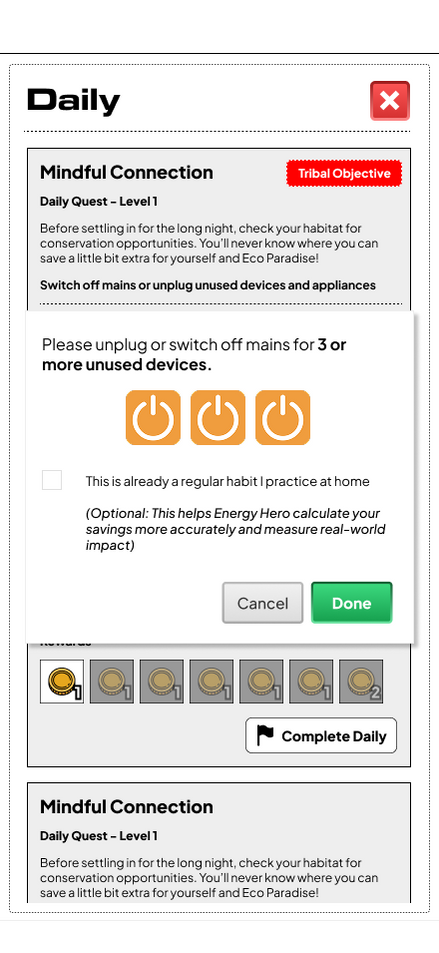
This particular Tribal Quest requires all tribe members to complete a daily quest to unplug or switch off mains for 3 or more unused devices. It is an opportunity to test the feature of Daily Tasks.
Daily tasks reward the user for simple habits done regularly.


View Usage & Improve
This provides a summary of electricity usage and conservation efforts to assess how well they did in a particular month. Examples of a ‘good’ month vs a ‘bad’ month are provided.
From interviews, many people note that billing can vary according to external events and circumstances. Therefore they can add tags as notes to provide context. Based on these tags, Energy Hero will recommend relevant challenges to help reduce consumption.
For prototype testing, I will also include a preview of a mid-level account.


Prototype Testing
I wrote a test script and tested the prototype with 3 participants. They were asked to click through the prototype and complete an onboarding flow and some basic tasks with minimal guidance. While they were using it, I asked them prompting questions and told them to think out loud to uncover valuable insights for product design and development.
Design Iteration
Initial Setup & Onboarding Questionnaire
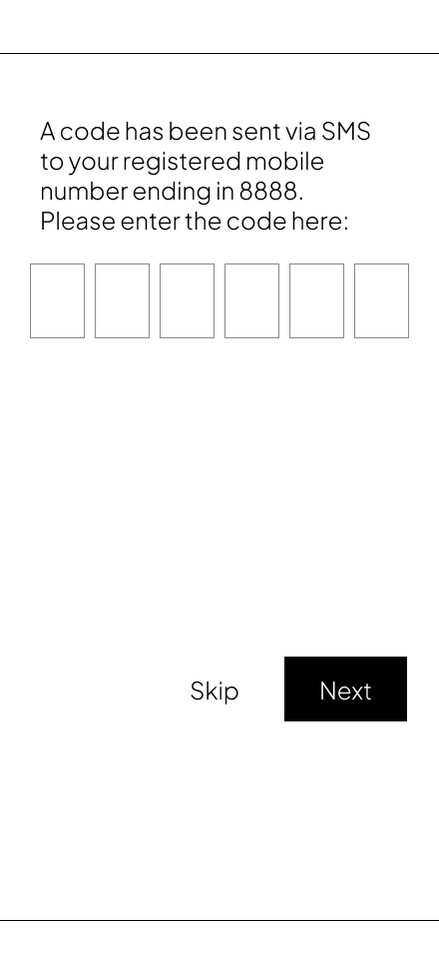
From testing feedback, players find the onboarding questionnaire easy to understand and complete on their own.
I added a Single Sign On feature where players can sign in using their existing utility provider account. Energy Hero will sync data from this account such as usage metering, past billing and household demographics. This will reduce the number of questions the app needs to ask in the onboarding questionnaire.




Introduction to In-game Lore
I provided a short introduction to the in-game world of Energy Hero the first time the player sets up their account and plays the game. This serves two purposes:
-
Provides the player with Epic Meaning and Calling as one of the core drives of gamification. This provides the player with a sense of importance that in-game activities are contributing towards a greater purpose.
-
Some players were uninterested in collecting customization items until I showed them a possible mid-game World Tree. By juxtaposing a Level 30 World Tree with a Level 1 seed, I appeal to the sense of Development and Accomplishment where players aspire to start their journey to eventually reach the maximum level.


First Challenge & First Level Up
Test participants were able to navigate this initial challenge on their own. However:
-
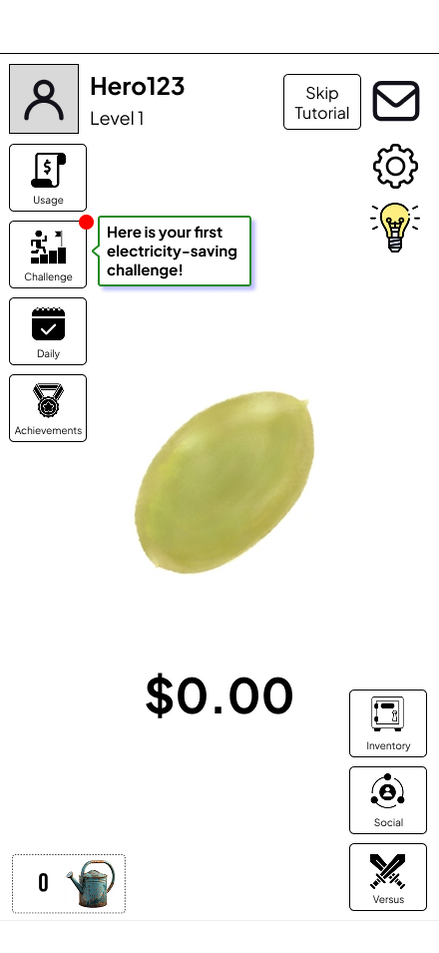
They took some time to understand what to do next or the meaning of interface elements. I replaced the arrow cues with tooltips containing helper text
-
After the challenge was complete, there was no feedback to indicate that progress was made towards this goal. I added a button for users to acknowledge that their challenge was complete
Interface Improvements:
-
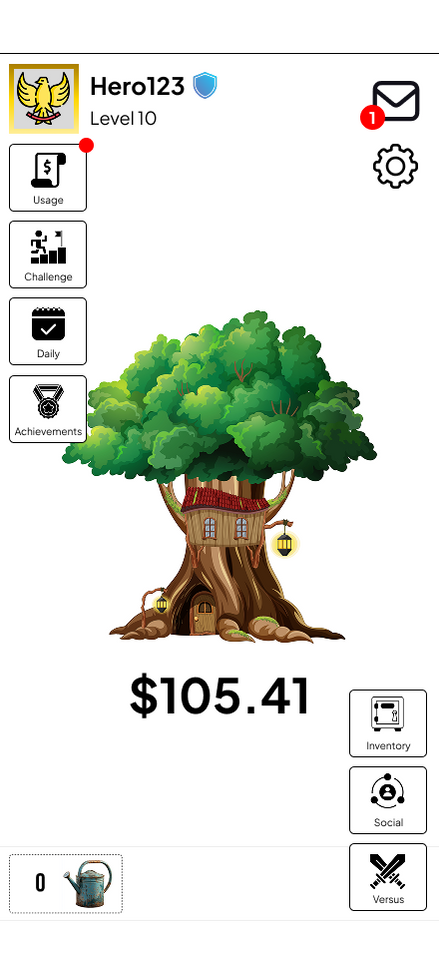
The ‘Versus’ button appearance was made consistent with the other features. This is a ‘good to have’ feature which will not be tested in detail
-
Button groups are standardized by aligning buttons vertically
-
I added a gear icon for Settings. This will be where the user configures account settings, security settings, display settings and so on.
-
I added a light bulb icon to help users discover new features on the app interface.



View Achievement and Claim Reward
Participants were able to perform this task on their own. However, it took a while for them to figure out where to click, even when I provided arrows. Therefore, I provided text tooltips to guide them on what to do next.


Equip Item In Inventory
-
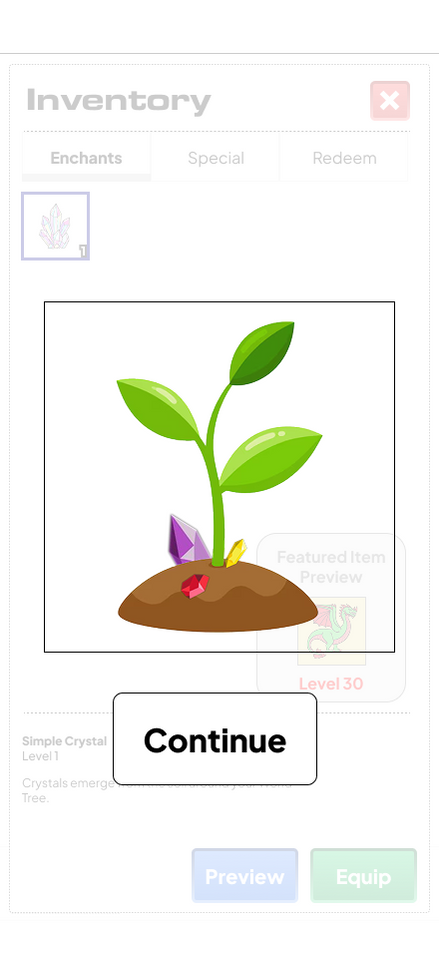
Participants were able to complete this task on their own. The previous navigation scheme, which used arrows to guide players on what to do next, was not clear enough, so I replaced it with text tooltips.
-
Instead of just listing Resources as a separate tab I should provide a means for people to spend their Resource rewards in a Redeem tab.
-
One participant was not too excited about World Tree customizations and their possibilities until I showed them a midgame tree later on in the session. After that, they enthusiastically asked me to include more customization options. Therefore, to avoid being constrained by the limited inventory items available in the very early game, I felt that I should include a preview of high-level items which would be available to players later in the game. This would motivate players to advance through the game to eventually collect these items, appealing to the sense of Development & Accomplishment and Ownership & Possession.


Friends List and Contact Management
-
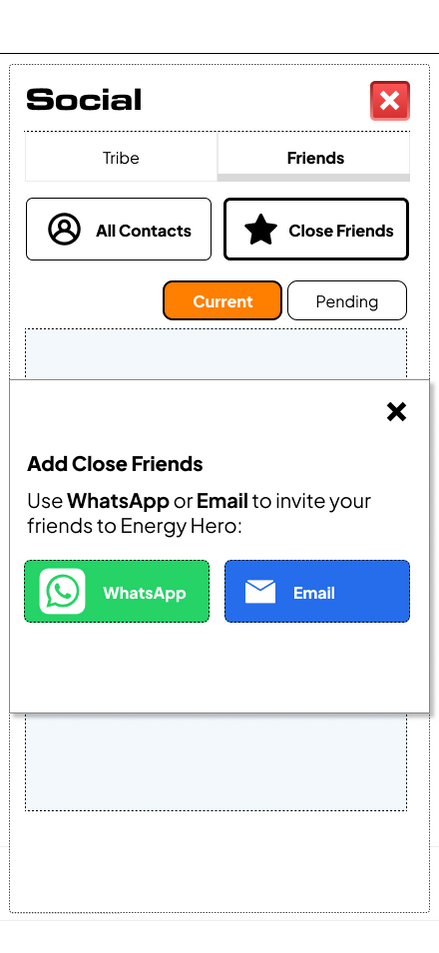
For the initial prototype, I assumed that new players would want to connect with veteran players through tribes, as this would maximize what they could accomplish with the app. However, during testing, participants immediately wanted to check out which of their close friends and family are already on the app so they can reach out to them and add them as contacts. Therefore, there is a need for me to implement the Friends feature in full to address this need.
-
To add someone from your contacts list to your friends list, you must import from your phone’s contacts. The other person must confirm the pending friends list invite. To prevent the contacts import feature from being misused, Energy Hero servers look out for abnormal contact list structures or abnormally large contact lists. Servers will never confirm if a phone number exists in the system.




Join a Tribe and View Tribal Quests
-
The Tribes List feature in the first prototype did not appeal to test participants because it did not show whether there were any tribes which may be connected to the player. Therefore, I added a feature to let players know if there are any members in these tribes whom they may know. Players may join tribes where many of their friends or family members are already members.
-
After joining a tribe, test participants did not notice the Message Of The Day. The Message Of The Day may contain important information to help new members get started and existing members work toward group goals. Therefore, I used a background colour and a glow effect to highlight the MOTD and draw attention to it.


Complete Daily Tasks
Participants did not have any difficulty understanding and completing their daily tasks. However, I had to be clearer about what are the rewards for this. I used coin icons and labelled them with a “Rewards” header.


View Usage & Improve
-
Participants knew how to navigate and understand their billing and electricity usage on the app. They also figured out correctly that the ‘Improve’ button would help them take steps to reduce their electricity usage. They found that the interface facilitates sharing and discussion with family and household members on their electricity usage.
-
However, they did not associate the red circle on the ‘Usage’ icon with new information available for the billing cycle. I had to use Notifications to push an alert to the player about this news. As players familiarize themselves with the app user interface, they will learn to look out for the red circle on menu buttons and associate it with something which requires their attention.
-
I changed the shade of blue on the usage ranking tier (Knight, Cultivator, etc) because a participant thought that it looked like an advertisement.
-
I added a sample notification which might pop up if the smart meter detects an energy spike. This will alert the homeowner to take steps to address its cause.


Validation of Value Proposition
Here is validation of the potential value provided by the app towards its goals of helping households save electricity gathered from participants:
“This game is a good way to encourage us to be more mindful of how we use our appliances efficiently”
“If I see that I've made significant progress I may share it with my own family”
“It's good to know people who share the same goals to save energy”
“If I see someone with a higher-level tree with all kinds of decorations, it is definitely a motivating factor. If I can see the progress is as such, it encourages me to do more and be consistent”
“When I have this app, it trains me to be more disciplined”
“If usage levels improve, I may want to share this with my family members.”
“Through this platform, you can share with friends and family if they have queries on how they can conserve electricity”
“Personalized electricity recommendations are good because not everyone faces the same issues at home”
“Overall it is very interesting as compared to other apps. More people would use this than the current apps we have for power supply and energy consumption”

Here is my deliverable for this Capstone Project: Based on feedback and insight from user interviews and prototype testing, I put together several high-impact changes to be included in this refined, validated prototype. The result is something that real users would want to use and helps them save electricity over the long term.